 Jason Townes French
The Curious Case of Corporate Context Rot
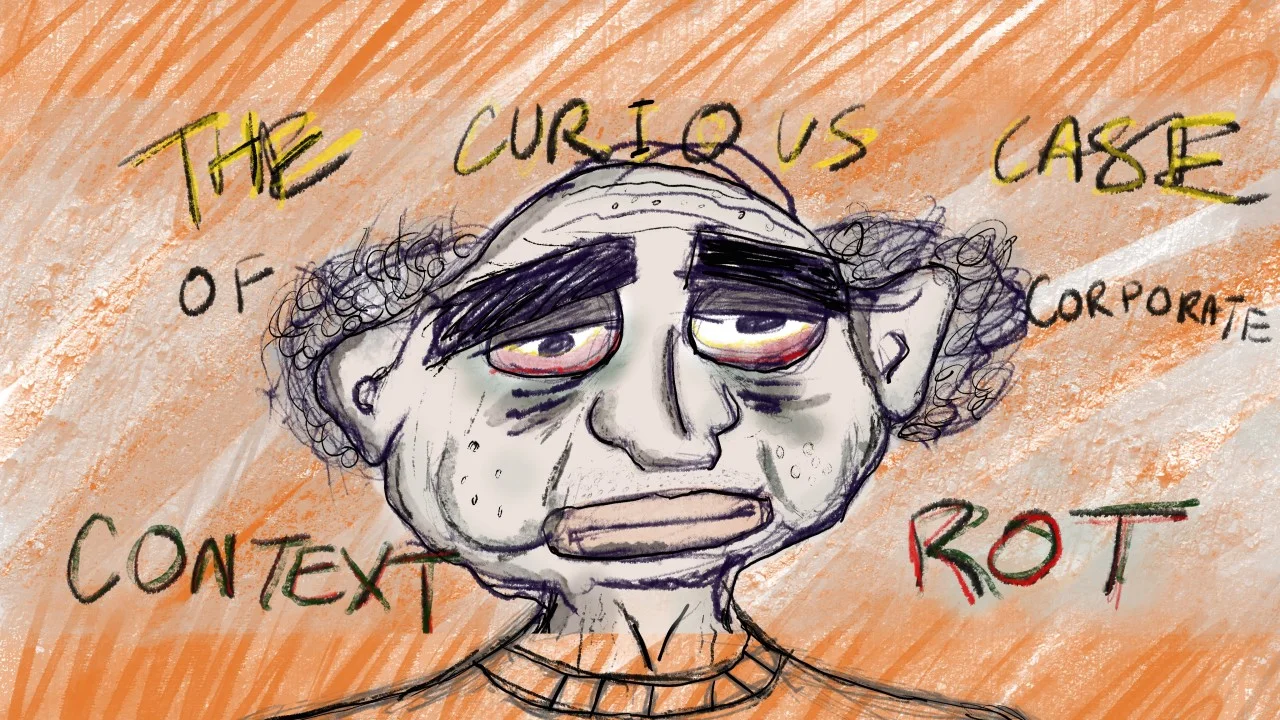
We've all been there before. You're knee deep in a long-running session with your AI of choice. Up to now, things have been going well. You feel like, “Cool, we're understanding each other. We're making progress. We're really solving stuff. We're getting somewhere.”
Then the conversation takes a turn and you realize:
“Oh no — it doesn't know what the hell it’s talking about.”
Claude (or Codex) is helplessly confused. It’s wrong about something so obvious to you, that you don’t understand how it could get something so fundamentally opposite of your intent. It’s totally off its rockers.
But things were all good just a prompt ago, right? You’re using a world-class model, with all the best data known to mankind right? So you take your first dose of copium:
“No worries. I'll correct it. I can fix this.”

Right? This is what we always think we can do, that we can just use more words to resolve this, similar to what we would do with another human, and that this will fix the AI's understanding of this concept. Phew! Crisis averted. You continue on with your conversation and everything appears to be fine…only to realize that now it's not really understanding something else, and you have to do the same process again on this other topic. Then it happens again. And again.
The unfortunate truth is that it's not going to ever understand you better. In fact, its ability to best understand you, believe it or not, was at the very beginning of the conversation, due to how large language model context windows work. The model’s ability to direct its attention to a needle in the haystack is best early in the conversation when the haystack was smaller. However, as it progresses, as it makes errors, as things inevitably deviate off track, each of those deviations, each of those misunderstandings becomes part of the model's context window, persisted with every request that comes up after that. So even if your feedback was to tell it not to do a thing, it's going to have in its memory that:
a) it does that thing,
b) that you will occasionally interject and say “don't do that thing”
Then from that standpoint, it'll have to decide whether or not it does or doesn't do that thing again, which means there's a chance it might do that thing. And every time it does that thing, and then you ask it not to, it might still do it again even more because at that point, there's more evidence of it doing that thing than there is of it not doing that thing in the context window.
When it gets to this point, nine times out of 10 there’s only one thing to do:

You got to shoot it in the head.
The “shoot it in the head” concept is what I believe is the genius behind the Ralph loop, which took over AI Twitter what seems like eons ago. It was one of these early agent design patterns in an industry hungry for repeatable strategies that work, where it was specifically designed to take advantage of how context windows are designed and avoid what we call the dumb zone.

The dumb zone is anything beyond that initial 40% of the context window, where by the time you get to that point in the agent’s context window, the agent ain't acting right. The rate of ensh*ttification compounds too quickly at that point. Any flaws that it has in it at that point are usually not worth attempting to recover from. There are errors in its understandings of things that have now embedded themselves in the context. And it's almost impossible to not accumulate this. It's like pollution. You're going to breathe some in. The idea with the Ralph loop is to get fresh air each breath instead of re-huffing and puffing in the same polluted air. It does this by clearing the context window (i.e. shooting Ralph in the head) with each iteration of the loop (a step that Anthropic admits they skipped in their initial implementation). This is to avoid the session-destroying phenomena knows as context rot.
Recommended by LinkedIn

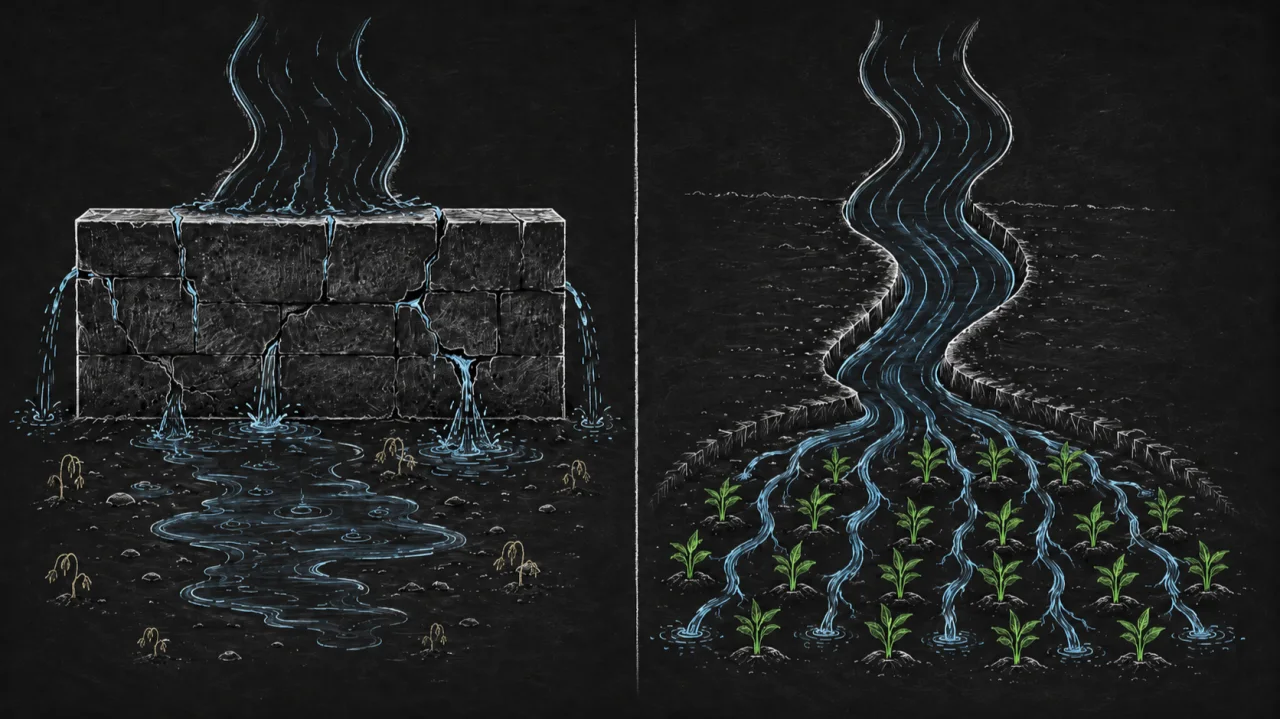
Context rot is one of the most frequently encountered issues when working with agents. Whenever you see Claude Code or Codex having to do compaction, it’s subtlety dealing with an existential crisis where it knows it’s effectively insane, but doesn’t want to tell you to shoot it in the head, so it tries to bargain with you via an offer of compaction. As Geoff Huntley would (probably) say, compaction is the root of all evil, and it’s usually almost always better to — you guessed it — shoot it in the head.
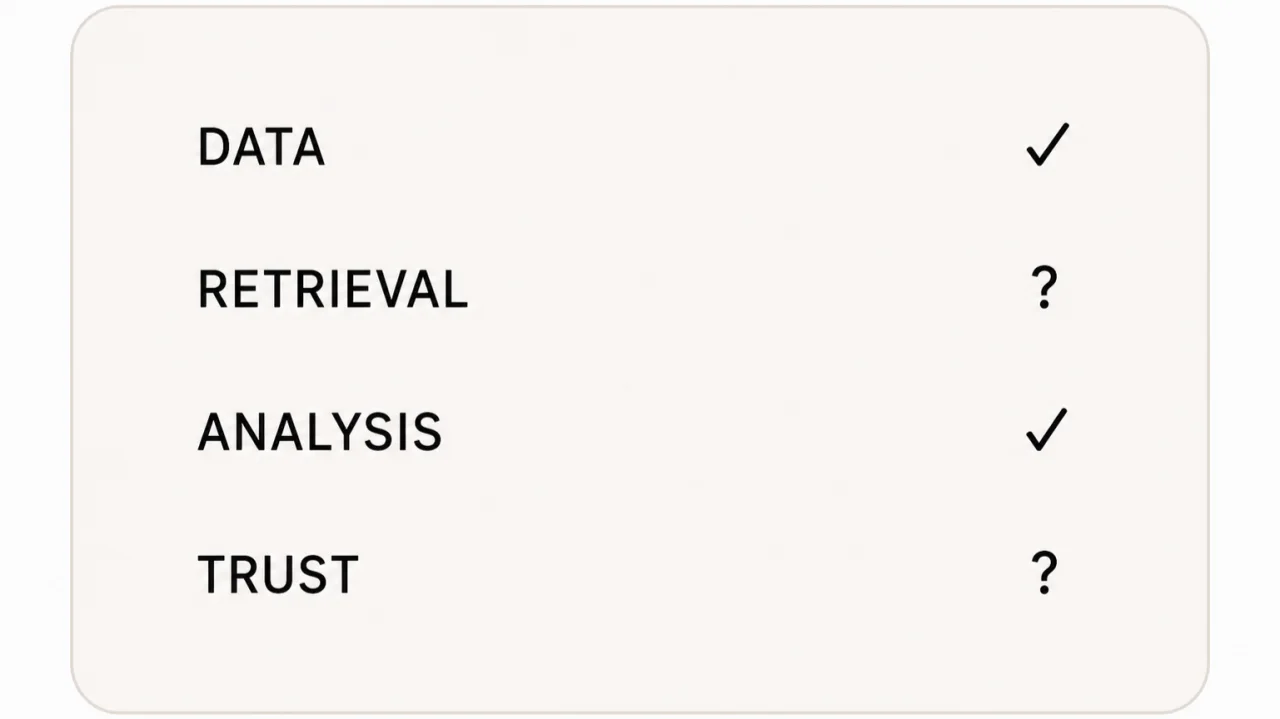
If running agentic loops has been one of the biggest algorithmic breakthroughs for agentic programming in 2026, context rot is the main enemy around which to strategize. In order for a loop to operate autonomously, indefinitely, and successfully, the main issue it has to navigate is this issue of rotting context windows. The context window may be usable, they are less trustworthy in that the context of the context window is no longer conducive to quality results. You don't fix that problem by adding more things to that context. The more it does, the stupider it gets. You fix that problem by deleting that context and starting with a new one.
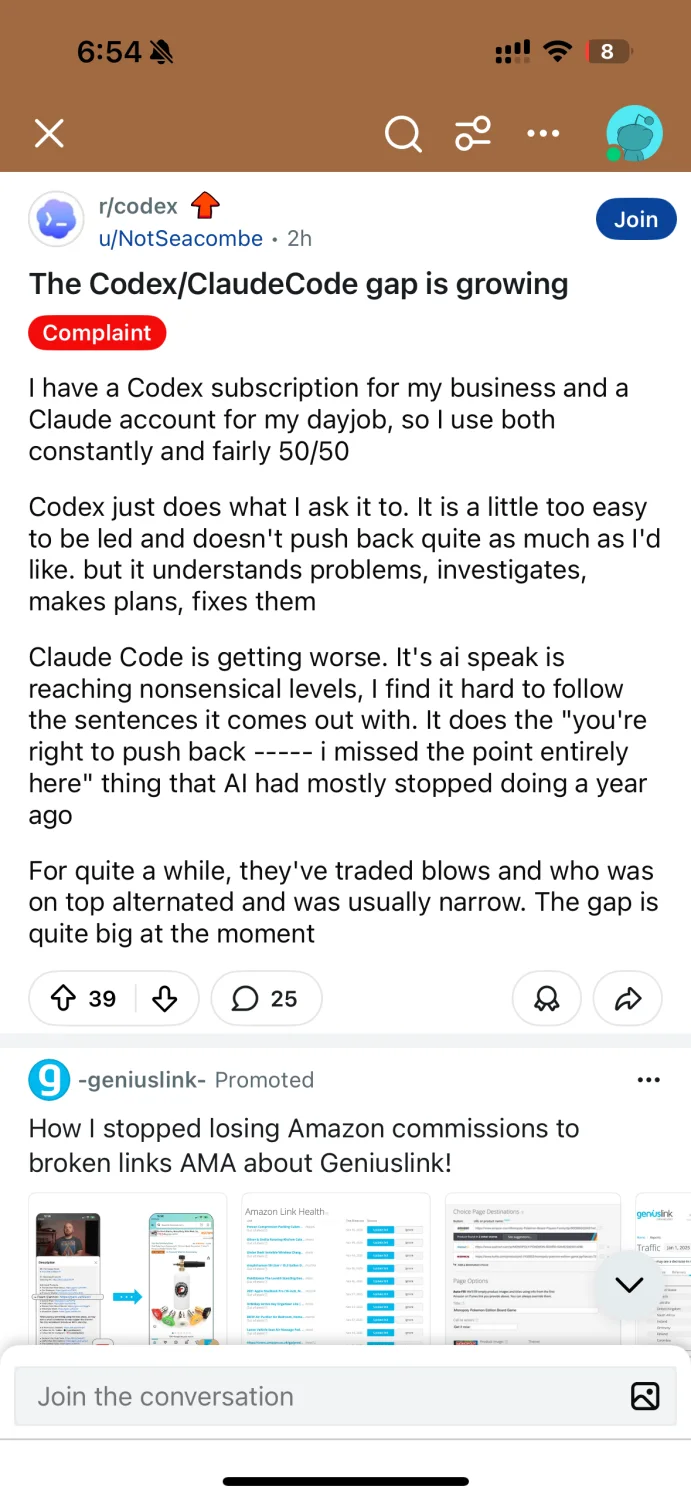
What if this concept of context rot could also happen at the corporate level? That is, what if a company that commits itself to using AI to do autoresearch and self-improvement loops, and dogfooding their stuff to the degree where they're solely eating their own dogfood, and their output is the byproduct of their dogfood? Could you conceivably get to a point where the context rot that is experienced in a single agentic code session could also be observed in a company that is operating agentically, using a shared context window that is in itself subject to the same rot? If this were to be possible, how would this manifest? What would this look like? Can we point to examples of this already happening currently? This is a question that has been swimming around in my head (alongside the original sins question I spoke about over here), in that, more and more with each release of a new version of a frontier model, I'm beginning to get the feeling that there might be a case of corporate context rot happening within the frontier labs themselves. I’ve come to this conclusion because it seems there's a huge disconnect between what they put out as the next version of their model and what actually passes the vibe check for people, for consumers, for people outside of those labs. At any given point, you can get on Reddit and look in the subreddits about AI and see people complaining about the new model version releases saying that they broke certain stuff. And while on one hand, it's not uncommon at all to see anyone go on Reddit and complain about anything, but at the same time, could there be something true to what everyone seems to be reacting to? I can admit myself that I've had moments like this.
For me the most stark example was when Claude Opus 4.7 came out. I was using 4.6. I had used 4.6 to run my first zero-error multi-day running Ralph loops. I was feeling very good about the state of agentic programming at that moment. I remember feeling “wow, even if it never got better than this, this is awesome” and I knew others who shared the sentiment. And then 4.7 came out, and it was just token-hungry and harebrained, saying a lot more, but doing a lot less. From my perspective, I'm wondering, “how could Anthropic perceive this as a better version?” I was genuinely bewildered wondering what are they seeing that I’m not, desperately looking for the positive use case that makes this obvious degradation worthy for Anthropic to a) release this, b) call it an upgrade.
What I didn’t’ appreciate however was the more obvious and also subtle truth: my eyes and the eyes of the people inside the frontier labs, are different eyes. I wasn’t alone though in what I was seeing. There are many others who spoke about this, and felt the same way. We all felt that Anthropic had shot itself in the foot. Then 4.8 came out, which most people I think agreed was better than 4.7, but still harebrained in many ways. There was still, and even to this day, a sizable group of people who still believe Opus 4.6 is better. So I find this bewildering to understand how does a company update their own product, with near perfect usage data, and make it less popular several times in a row? And we’re supposed to follow their lead and do the same? How does that work? And it's not like this is a company that isn't familiar with the concept of a feedback loop and progressively updating. Something had happened.

There was a point where I was watching a YC talk with Andrej Karpathy, and something really hit. He mentioned how the people outside of frontier labs (referring to the audience) have a huge advantage specifically because they're not within the frontier lab. At first I thought, okay, maybe this guy's just trying to blow some smoke up people's ass. It would seem like the people at the frontier labs have the most insane advantage to anyone. They have access to real mythos and real fable and all this kind of stuff, right? They've got unlimited tokens. Isn't that a huge advantage right there in itself? And of course, it is. But it then dawned on me that they don't have the thing we have, which is the ability to approach this type of technology with differently biased eyes from a unique real-world perspective, with constrained resources. Because it's really hard within a company to not think like the people at your company. That in itself creates a collective context window that is subject to context rot, which could then potentially explain what I was seeing with these model releases that just didn't seem to be trending in the right direction. It could be what explains this phenomena.
So the more I thought about this, the more it dawned on me that this actually might be something. This might be exactly what we're seeing because it just doesn't make sense to me otherwise how what was being offered from these labs could differ so greatly from how the users experience it. This concept of corporate context rot seems to really fill that gap in terms of explaining this phenomena because we know these companies care deeply about these products. We know they're very capable and, of course, are experts in shipping quickly and responding to feedback quickly and iterating quickly. They are literally the grand wizards of feedback loops. So it would be just absurd to think that they're not good at doing feedback loops, which means, it's not that they're not doing these things. It's they are doing these things, and somehow the ingredients of what they're using in itself has these faults, and this is the output it generates. In other words, corporate context rot.
The more I explored this, the more I understood a uniqueness that we have as people outside of these bubbles. It reminds me of my days at Apple when the iPhone had just come out. Like many people worldwide, many of us internal to Apple were completely enamored with the iPhone and wanted to go build apps for it. Those most motivated to make apps for this new platform had to quit Apple to do so. Aside from conflict of interest, building apps for a platform like that, at that point in time, meant you’d probably have to go start your own company and give yourself enough time play around with it to find unexpected use cases. That wasn’t going to come from within Apple, which already had adopted a particular attitude towards what app development meant to Apple.
Corporate context rot is something to keep in mind in this agentic era — both if you're inside a frontier lab and you are directly subject to this, and if you're outside a frontier lab, and you should consciously use it to your advantage and so you also don't accidentally adopt the the corporate context rot of the frontier labs. It's important to stimulate your own ideation and not purely just go off of, let's say, tech talks from the frontier labs themselves. Their ideas are well-informed and generally good to understand, but what's even better and where you will have more alpha is in coming up with your own ideas based on your own experiences. That's where the real money is. Because if something is in a publicly available tech talk from Anthropic or OpenAI, every entrepreneur also has access to that same tech talk, taking whatever gains you get from that and giving it to everyone. It’s no longer an idea that you believe to be true and everyone else thinks is false, as YCombinator would put it. These first-party perspectives are good to know, but it's important to lean into the muscle of finding your own ideas because that's where the most treasures are going to be found.
Now let's say you are inside a frontier lab. What advice could I give to an earnest member of the technical staff at a frontier lab who wishes to be productive within the context of their company, yet at the same time not be victim of the bias of their company? This is a tricky problem, because part of joining a company is adhering to a certain culture, sharing a certain set of beliefs, and doing things a certain way.
An extreme top-down way of doing this is to switch out the staff of the company or move teams around frequently to make sure that ideas stay new and reduce the likelihood of teams falling into the "this is how we've always done things" trap. This introduces other problems such as, how do you then maintain a base of continuity while also appreciating that it is that very base of continuity that is causing the corporate context rot. So a pruning function for deciding what remains of your corporate context window and what goes (and most of it should go). That's the only way that this works long-term without just converging to rot.
A more bottom-up way would be to make sure as an individual team member, that you approach each problem first as an individual, and give your brain a chance to do its spooky magic where it can pull in data from its biologically-accessed RAG database and give you some fresh alpha. Make sure to start at least the first 30% of each new task that way before bringing Big Brother into the chat.
So what other lessons can be learned from this idea of corporate context rot? Maybe this is an opportunity to take things a level deeper and really dig into the mystery of the human experience in our own consciousness. Our brains appear to have some sort of memory, right? We don't know where they are exactly, but we have some general ideas. It's not clear how big that memory is. It's not clear exactly when things get written to or deleted from, but there does seem to be some kind of hierarchy based on importance, and we use that to distribute our attention. How does this attention distribution mechanism work within our own bodies? It’s not very clear. Maybe the real lesson there is that, we're not capable of fully understanding it. That right there is the unique advantage of being a human — we have superpowers that even humans don’t understand, and certainly no LLM can replicate. As humanity enters this era where more and more companies will be running on these agentic loops, and we find ourselves wondering: how do we make ourselves valuable? Maybe this is one of those ways. If there’s a list of things that only a human can provide, maybe the ability to intuitively manage context in a way that avoids rot is on that list. Maybe companies that maintain the right people and empower them to be stewards of their context, both declaratively (with files) and intuitively (with vibes) will yield higher quality results. Maybe that's the only true way to avoid the curious case of corporate context rot, or at least to better manage it. Maybe one of the highest leverage intuitive human tasks is making the call when to just “shoot it in the head” and start new.
Have you seen any cases of corporate context rot? Let me know what you think.
Originally published on LinkedIn.