 Jason Townes French
Playing the Model: A Developer's First Look at WHAMM's Generative Quake II
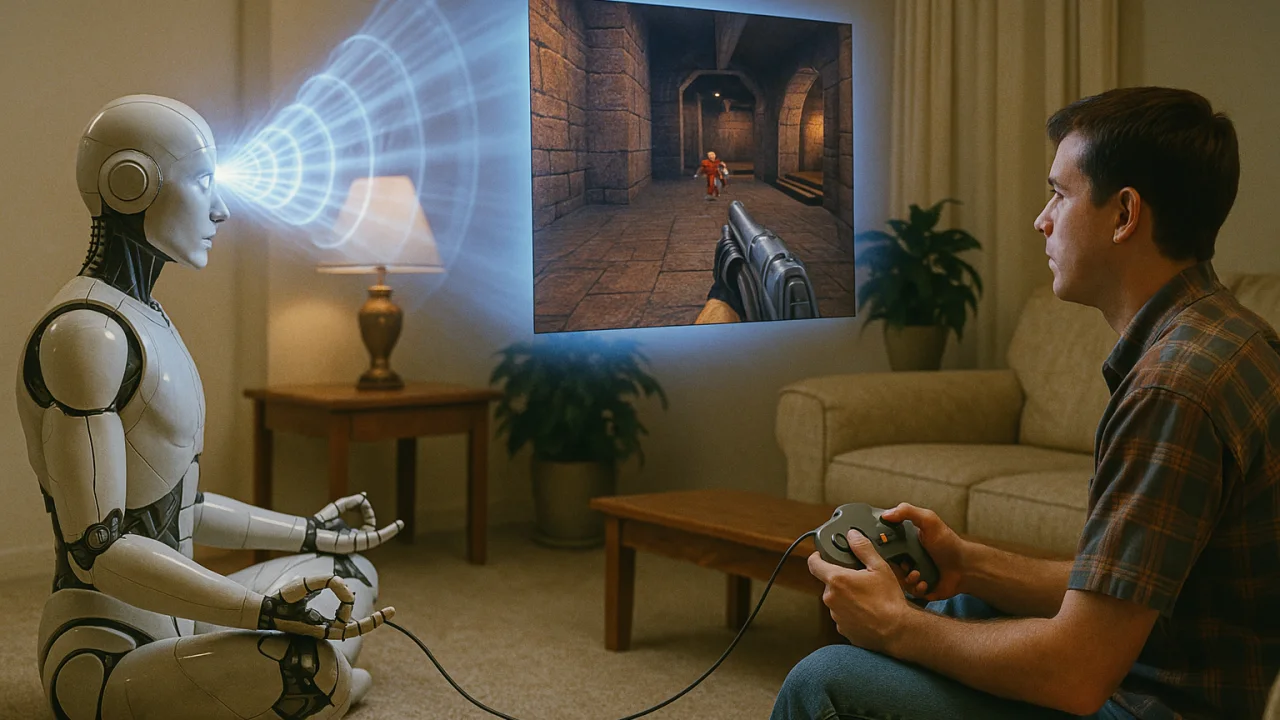
The rockets fly through walls. The enemies morph between grotesque forms like a fever dream. The textures shimmer with an impressionist's brush. And yet, I'm playing Quake II—or rather, a simulacrum of Quake II being hallucinated into existence frame by frame by an artificial intelligence that has never written a line of C++. Welcome to gaming's event horizon, where the familiar rules of interactive entertainment begin to warp beyond recognition.
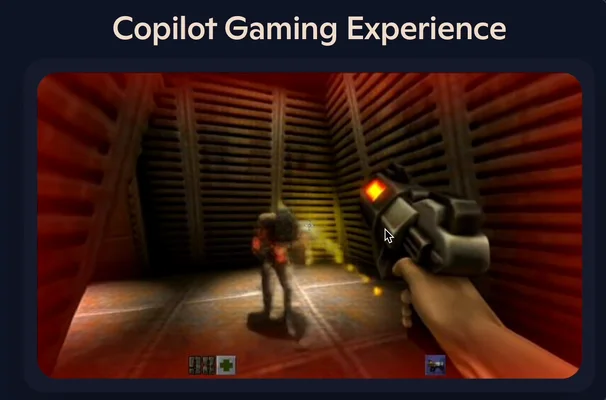
Microsoft's World and Human Action MaskGIT Model (WHAMM) represents nothing less than an ontological rupture in how we conceive of digital worlds. Where traditional game engines meticulously calculate trajectories, collision detections, and state changes through deterministic algorithms based on pre-defined game data, WHAMM simply... guesses. It predicts what Quake II should look like and how it should behave based on what it's seen in a curated week of professional gameplay, creating reality through statistical inference rather than explicit instruction. The technology feels less like programming and more like summoning—a computational séance that conjures the ghost of Quake II from the recesses of its own digital imagination.
And against all rational expectation, it works. Mostly.
Ghosts in the Machine: The Technical Underpinnings
To understand the paradigm shift WHAMM represents, imagine attempting to predict the next measure of a symphony not by reading the sheet music, but by listening to thousands of performances and developing an intuition for where the notes should go. That's essentially what WHAMM's transformer architecture (utilizing distinct 'Backbone' and 'Refinement' models totaling roughly 750 million parameters) does, taking discretized player inputs (joystick positions quantized into 11 buckets) and predicting the next frame of gameplay as a collection of 576 visual tokens that represent both the visual output and underlying game state.

The architectural evolution from WHAM to WHAMM is where traditional boundaries dissolve. WHAM operated like a conventional language model, autoregressively generating one token at a time within 1-second context windows at a resolution of 300 x 180. WHAMM, however, adopts the revolutionary MaskGIT approach—instead of the slow, sequential generation of tokens, it predicts masked tokens in parallel and then iteratively refines the full set of image tokens through strategic masking and prediction cycles. This parallel processing achieves real-time response times for larger 640 × 360 frame predictions, creating a continuous generation rate of 10Hz. In human terms: the system thinks in broad strokes and fine details concurrently, just fast enough to fool you into believing you're playing a game rather than watching a particularly responsive AI hallucination.
What makes this hallucination so convincing is the model's training corpus—while WHAM feasted on Bleeding Edge gameplay data spanning seven years, WHAMM achieved its Quake II prowess through a remarkably efficient data diet: just one week of curated gameplay from professional testers. Microsoft's researchers essentially traded quantity for quality, focusing on a single level with intentionally diverse gameplay scenarios. The result is a model that can recognize rocket launchers, simulate explosions, and even "remember" the secret areas of Quake II's first level—at least until you look away for more than 0.9 seconds, at which point the model's goldfish-like memory kicks in and it might just forget that rocket-wielding enemy was about to turn you into digital confetti.
The technical achievement cannot be overstated: an AI watched professional gamers play for just one week and can now recreate a close proxy in real-time, conjuring environments, enemies, and explosions from pure imagination—responding to your inputs as if it had been coded.
Through the Barrel of a Probabilistic Gun
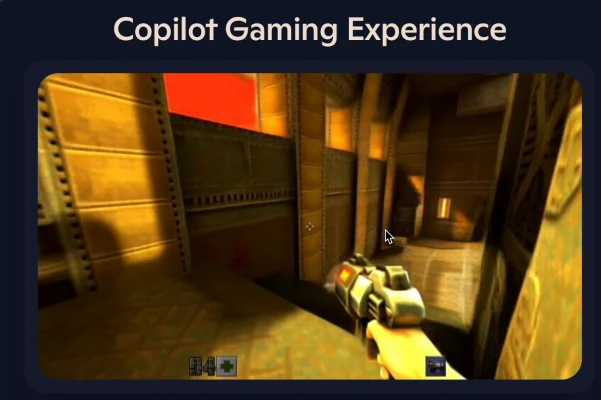
The uncanny valley has never been so literal as when navigating WHAMM's interpretation of Quake II's corridors. The visual fidelity often maintains impressive structural coherence with the original assets, but everything feels filtered through a fever dream—textures exhibit a "painterly" quality reminiscent of VQGAN's token reconstruction process. The enemies are recognizably "Strogg", until they aren't—morphing between character types as the model's latent space struggles to maintain entity consistency beyond 1-second intervals.
Movement physics retain a surprising fidelity to the original: stairs and ramps feel about right, walls behave like walls, and weapon recoil patterns maintain directional consistency. But push at the edges, and reality begins to fray. Projectiles occasionally pass through walls, and health packs sometimes stubbornly refuse to behave correctly. In these moments, you're reminded that you're not playing a game—you're participating in an AI's best guess at what a game should be.
The most transcendent moments, however, arise from WHAMM's delightfully bizarre behaviors. During one firefight, I killed a Strogg soldier and watched its remains crumple into a heap of polygonal gore, only for the enemy to spontaneously reassemble itself moments later—the AI equivalent of "just kidding!" Such unintentional resurrection acts—completely absent from the original game's design—showcase both WHAMM's improvisational nature and its tenuous grasp on persistent reality. The trade-off for this computational necromancy? Consistency: enemies flicker between states of existence like quantum particles, and the poor AI sometimes forgets you were in mortal combat when you briefly look away, shattering the already paper-thin illusion of coherence. This can lead to new types of gameplay, however, something Microsoft refers to as playing the model.
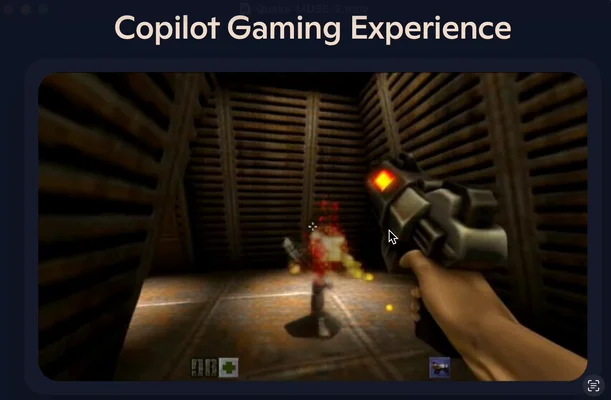
Latency remains the most persistent reminder that we're in uncharted territory. The model's short 0.9-second context window limits its memory, while perceptible input latency remains a challenge for exploratory play, but in the heat of Quake II's signature combat sequences, the input lag disrupts the balletic precision that defined the original experience. Inputs queue improperly during intense sequences, creating a disconnect between intention and action that are hard to fully disguise at this current stage.
And yet—the mere fact that we can critique the playability of a game being dreamed into existence in real-time by an AI speaks volumes about how far we've come. And it will only get better.
Beyond Code: The New Frontier of Game Creation
The rise of generative gameplay doesn't just challenge how we play games—it fundamentally re-imagines how we make them. The traditional programming paradigm—deterministic C++ systems orchestrating predictable outcomes—gives way to a new trinity: prompt engineering, latency optimization, and hybrid systems integration.
Debugging transforms from finding logical errors to investigating training data biases. Microsoft's case studies show how gameplay bugs in this paradigm stem from biased training data rather than code errors, necessitating new visualization tools for model decision boundaries and token activation patterns. Gone are the days when "works on my machine" was a developer's excuse—now it's "worked in the training set."
For artists, WHAMM's VQGAN-based asset generation enables unprecedented stylistic flexibility—switching from Quake II's industrial grit to cel-shaded whimsy requires merely adjusting initial prompt tokens. But this power comes with a price: texture consistency varies noticeably between frames, and model-generated weapons sometimes lack critical detail. The artist's role shifts from creating definitive assets to defining visual grammars—token distributions that guide rather than dictate the final output.
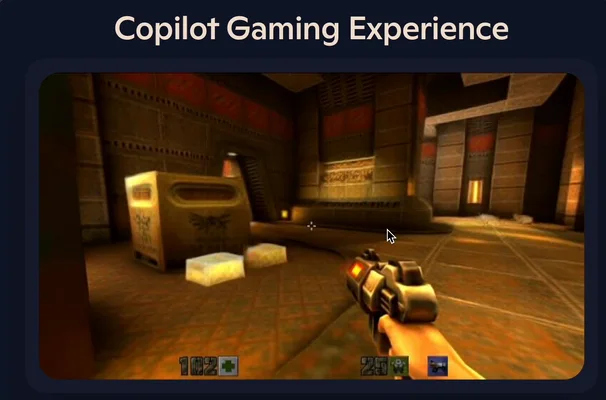
This visual variability suggests an intriguing opportunity for technologies like NVIDIA's Deep Learning Super Sampling (DLSS). Just as DLSS uses AI to upscale lower-resolution game rendering to create higher-fidelity outputs, a similar approach could potentially stabilize and enhance WHAMM's generative output. By applying real-time deep learning image enhancement to the raw WHAMM-generated frames, developers could smooth out texture inconsistencies, sharpen weapon details, and maintain visual coherence across sequential frames—all without requiring the base model to generate at higher resolutions. This hybrid approach would leverage the creative flexibility of generative models while addressing their inherent visual limitations, potentially achieving both the imaginative freedom of AI generation and the polished finish of traditional rendering pipelines.
Quality assurance faces perhaps the most existential disruption. How do you test a game that never exists in the same state twice? Microsoft's approach employs statistical boundary testing, adversarial prompting, and emergence monitoring through clustering algorithms. These methods identified critical failure modes in the Quake II implementation—including infinite health pack generation loops—that traditional playtesting would likely miss. The QA engineer of tomorrow looks less like a meticulous bug-hunter and more like a digital anthropologist studying the behaviors of a newly discovered artificial ecosystem.
Digital Dreams and Silicon Nightmares
For all its promise, WHAMM exists at the bleeding edge of technical possibility. Its significant computational demands—exceed current console capabilities, restricting deployment to high-end PCs or cloud streaming services. Even with current high-end GPUs, maintaining high frame rates may require significant performance compromises like resolution scaling.
Multiplayer implementation reveals even more fundamental challenges. Without deterministic game states, players can quickly experience significant divergence in environmental details and enemy positions, leading to rapid desynchronization of physics objects. Potential solutions like consensus-based generation likely introduce prohibitive latency. The social experience that defined Quake II's legacy becomes nearly impossible to replicate in this generative paradigm.
The Map Is Not the Territory—But Soon It Might Be
Looking toward the immediate horizon (2025-2027), hybrid architectures combining WHAMM with traditional engines for critical systems like collision detection offer the most promising path forward. Custom silicon optimizing transformer inference could significantly address latency issues in the coming years.
The longer view (2028-2030) suggests even more profound transformations: full-game generation from textual prompts, dynamic narrative systems evolving based on player psychology profiles, and cross-title transfer learning creating a universal game model adaptable to any genre. The ultimate promise is nothing less than the democratization of game creation—a world where anyone can conjure interactive experiences through natural language description.
Yet this democratization comes with its own set of tensions. As the technical barriers to game creation fall, the questions of creativity, authorship, and artistic vision become more acute. Will we value games dreamed by algorithms as highly as those crafted by human designers? Can an AI-generated experience capture the distinctive voice that has defined gaming's most celebrated auteurs? How does this impact the human role of game design?
The Uncanny Playground
The WHAMM-powered Quake II prototype represents gaming's uncanny valley moment—impressive enough to astonish, yet imperfect enough to unsettle. Its strengths in emergent gameplay and dynamic content generation stand in stark contrast to its weaknesses in consistency and latency. The bullets may occasionally pass through walls, and the enemies might morph mid-combat, but the mere fact that these behaviors emerge from statistical inference rather than explicit programming represents a paradigm shift comparable to or even greater than the leap from 2D to 3D rendering.
For the industry, successful adoption requires more than technical solutions—it demands a philosophical reconsideration of what games are and how they're made. Development pipelines must be reimagined and new skill sets cultivated. The immediate path forward lies not in replacement but augmentation—using AI as a collaborator that expands human designers' creative possibilities rather than supplanting them.
As I navigate WHAMM's dream-like interpretation of Quake II's familiar corridors, I'm reminded of that moment in the late 1990s when 3D acceleration first transformed gaming from blocky abstractions to textured immersion. The technology was imperfect—frames dropped, textures warped, and polygons clipped—but it was unmistakably the future. WHAMM feels similarly transformative, a glimpse of gaming's next frontier through a glass, darkly.
The rockets may fly through walls, and the enemies may shift like digital phantasms, but we are witnessing nothing less than the birth of a new medium—one where games aren't built, but dreamed. We are definitely not in Kansas anymore. We've stepped through the looking glass into a world where the rules of reality itself are negotiable, probabilistic, and ever-shifting.
And that, despite all its imperfections, is nothing short of amazing.
Originally published on LinkedIn.